Key Takeaway
Paying percentage-fee consultants on a $150K-$400K SR&ED claim costs 3-10x more than software, and continuous capture produces stronger CRA documentation than retrospective interviews.
If you’re looking for an SR&ED consultant, you’re probably at a specific point: you know the credit exists, you know your company qualifies, and you need help getting the claim done. That’s the right problem to be solving.
This guide covers what to look for when evaluating consultants, the main firms operating across Canada’s major tech hubs, and the honest case for when software does the job better. If you’ve already read our take on SR&ED consultants vs. software, this is the more tactical follow-up.
What Should You Look for in an SR&ED Consultant?
Not all SR&ED consultants are equal. The industry includes Big 4 accounting firms, dedicated SR&ED shops, boutique solo practitioners, and general accounting firms that handle SR&ED alongside everything else. The quality gap between them is real.
Software-specific experience matters most. SR&ED was built for labs and manufacturing floors. CRA’s framework (technological uncertainty, systematic investigation, technological advancement) was designed with physical R&D in mind. Applying it to software requires a consultant who understands how dev teams actually work and can articulate machine learning experiments or distributed systems debugging in CRA’s language. Ask directly: what percentage of their current client base is software companies? What’s the largest software SR&ED claim they’ve prepared?
Contemporaneous documentation is the audit differentiator. CRA has been explicit about preferring records created during or shortly after the work, not reconstructed months later. Ask any consultant how they collect technical information. If the answer is retrospective interviews in Q1, that’s a known limitation. It’s not a dealbreaker, but it affects how much qualifying work gets captured and how well your documentation holds up under review.
Fee structures are negotiable. The standard percentage-of-claim model (15-30%) was set decades ago when the entire documentation process was manual. Consultants with efficient processes often move to flat fees or tiered pricing for ongoing clients. If you’re signing a multi-year engagement, the initial percentage should come down over time.
Audit history is the real credential. Ask how many audits they’ve managed. What percentage resulted in full claim approval? A consultant who has handled 30 software company audits has developed CRA response patterns that a less experienced firm can’t replicate.
Which SR&ED Consultants Are Worth Looking at by Region?
The Canadian market is concentrated in Toronto, Vancouver, and Calgary, with smaller clusters in Montreal and Ottawa.
Toronto
Toronto has the densest SR&ED consulting activity in the country, tracking its tech sector size.
SR&ED Partners is one of the most recognized dedicated SR&ED firms in Ontario. They focus exclusively on SR&ED, no general accounting, and have a large software client base. Their technical reviewers tend to have engineering backgrounds, which produces better documentation for software companies than generalist firms.
MNP operates a large SR&ED practice out of Toronto with significant capacity for mid-market tech companies. They’re stronger on the financial and filing side than on technical narrative quality. A reasonable choice if your claim involves complex expenditure allocations across entities.
WS+B (previously SR&ED Consulting) is a boutique firm known for aggressive claim preparation and strong audit defense. They have a loyal client base in Toronto’s SaaS community. Fee structure runs at the higher end of the market, but their audit track record is worth examining if CRA scrutiny is a concern for your sector.
BDO Canada has SR&ED practices across its Ontario offices. A solid mid-market option, particularly for companies already using BDO for audit or tax. The SR&ED technical depth depends heavily on the specific team you work with.
Vancouver
Vancouver’s market is smaller but competitive, with strong boutique presence serving the province’s tech community.
Ayming Canada operates nationally with a meaningful Vancouver presence. They bring European R&D tax credit methodology into their Canadian practice. A good option for companies with cross-border R&D or multi-jurisdiction complexity.
Forward SR&ED is a Vancouver-based boutique focused almost entirely on tech companies. Small team, high-touch approach. They typically work with 50-person-and-under software companies and run a more collaborative process with engineering teams than larger firms.
KPMG’s Technology practice covers SR&ED for larger tech companies in BC. Better suited to $50M+ revenue companies. If you’re that size, their tax credit optimization and multi-entity experience justifies the premium.
Calgary
Calgary’s SR&ED market has historically been energy-sector-dominated, but the tech community has grown enough to support specialized practices.
Swanson Reed operates nationally with a Calgary presence. Australian-founded with R&D Tax Incentive background, they’ve built a Canadian practice focused on reducing documentation burden. Their process is more systematized than relationship-driven.
Grant Thornton has SR&ED capabilities in Calgary that work well for companies in the $5M-$20M revenue range doing hardware and software R&D. Stronger fit for energy tech, cleantech, and industrial software than pure SaaS.
Montreal
Montreal’s SR&ED scene benefits from Quebec’s additional provincial R&D credits. The federal SR&ED stacks on top of Quebec’s program. Consultants who understand the combined picture add real value here.
Deloitte’s Quebec technology practice handles the largest and most complex claims in the province. The right choice for companies with $400K+ in combined federal and provincial R&D credits or multi-entity structures.
RSM Canada has a growing SR&ED practice in Montreal with a focus on tech and life sciences. Mid-market positioning, reasonable fees, and genuine software experience on their technical team. A solid option for Montreal-based companies in the 25-50 employee range.
How Do You Evaluate Any Consultant Before Signing?
Regardless of region or firm size, run these questions before you commit:
- What percentage of their portfolio is software companies?
- What was the outcome of their last three CRA audits?
- Can they provide a reference from a company similar to yours in size and industry?
- What’s their typical timeline from engagement start to filed claim?
- How do they handle scope if your claim grows significantly year over year?
The answers reveal more than any firm’s marketing. A consultant who gives vague answers to these questions isn’t ready for your business.
When Is Software the Better Fit?
Every firm above provides real value. But for a specific profile of company, SR&ED documentation software beats them on cost, documentation quality, and engineering time.
The profile: a Canadian software company, 25-50 employees, 5+ developers, actively using git-based workflows and issue tracking, with a minimum $100K annual claim. If that’s you, here’s what changes.
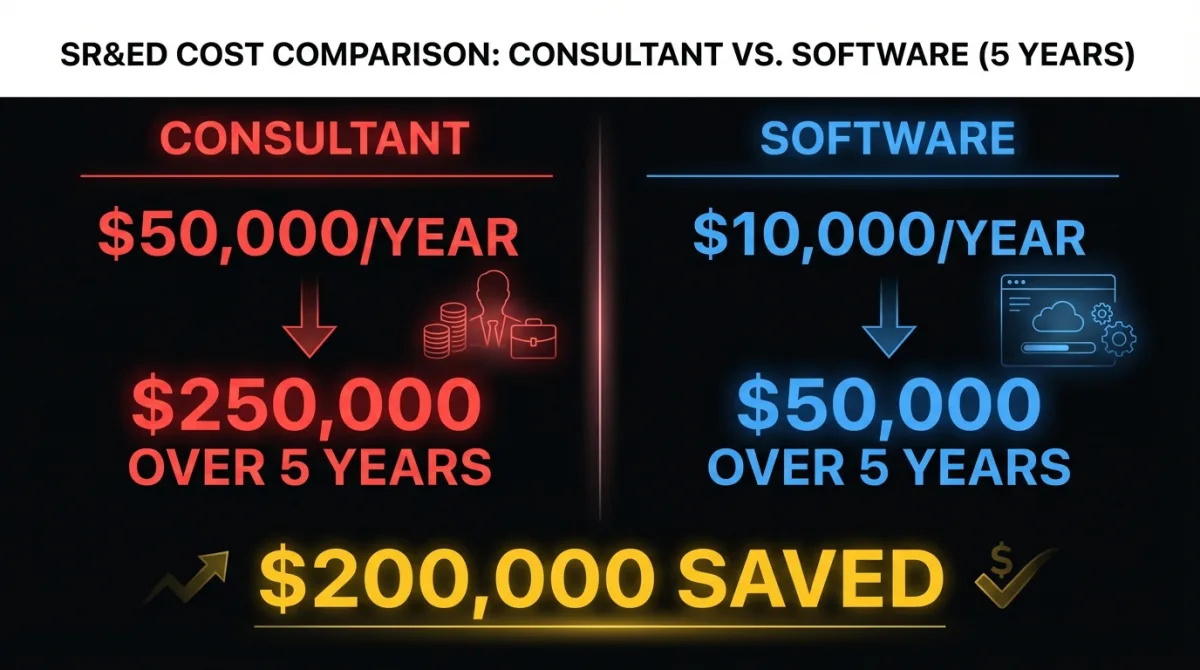
The cost gap is large. A $200K claim at 25% costs $50,000/year in consultant fees. SR&ED documentation software costs $5,000-$15,000/year. Over five years, the difference exceeds $175,000.
Continuous capture catches more qualifying work. The retrospective interview model misses projects engineers have forgotten and produces vague descriptions of technical uncertainty for projects they half-remember. Software that connects to your GitHub, GitLab, or Jira captures qualifying work as it happens. Commit histories, PR discussions, and ticket details contain the specifics CRA wants. Those specifics exist in your dev tools, not in your engineer’s memory eight months later.
CRA values contemporaneous records. This isn’t a software marketing claim. CRA’s documentation guidance explicitly notes that records created during or shortly after the R&D activity carry more weight than records reconstructed for filing purposes. Continuous capture produces exactly those records.
Your engineers stay focused on building. SR&ED interviews typically consume 4-8 hours per engineer per year. On a 10-person dev team, that’s a full sprint’s worth of capacity redirected from product work to recalling last year’s technical decisions. Software eliminates this.
Setup is minimal. Connecting your dev tools takes minutes. The first documentation draft generates immediately. There’s no months-long onboarding engagement.
How Does the Hybrid Model Work?
For companies that want the cost efficiency of software and the strategic coverage of a consultant, the hybrid approach makes sense.
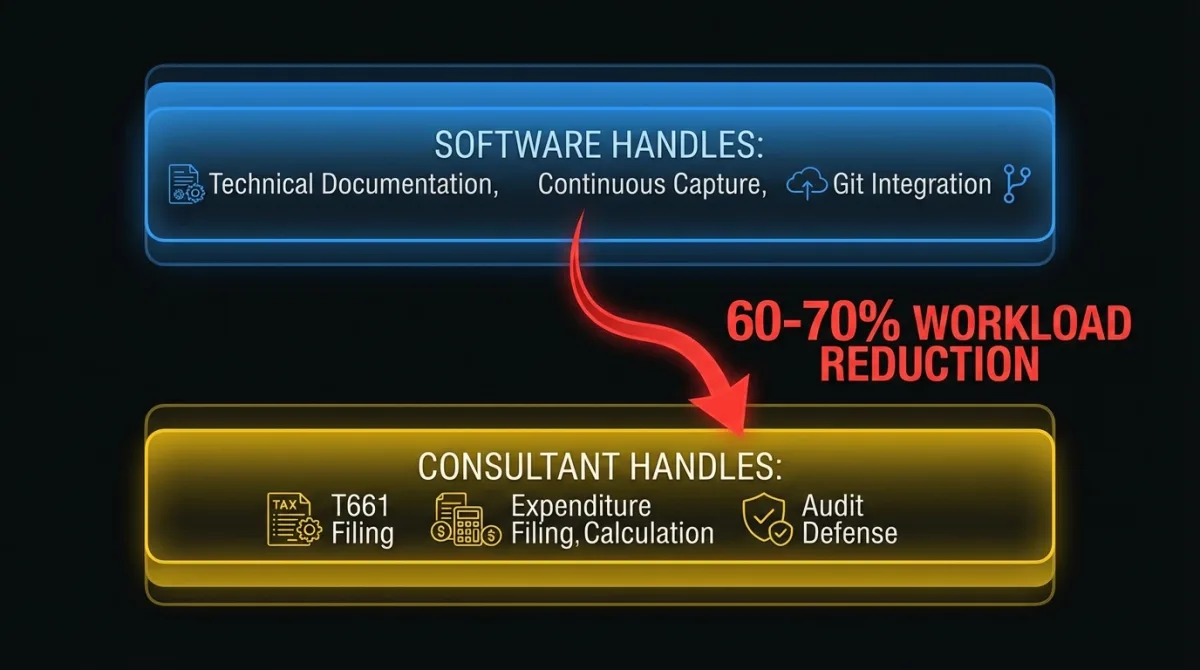
Chrono R&D handles technical documentation. A consultant, engaged at a reduced flat fee, handles expenditure calculations, T661 preparation, and audit defense. The consultant’s workload drops by 60-70%, which is the basis for renegotiating their fee. You get CRA-ready documentation with human expertise where it matters most.
What About the T661 Form?
One thing doesn’t change regardless of which path you choose: the T661 form is the backbone of your claim. CRA evaluates what’s on that form. Understanding what CRA looks for in each section, especially the technical uncertainty, systematic investigation, and technological advancement fields for software projects, helps you evaluate the quality of whatever documentation you’re getting. If your current consultant’s T661 narratives are vague, short, or lack technical specificity, that’s the risk worth addressing before the next filing.
Frequently Asked Questions
How much do SR&ED consultants charge in Canada?
Most SR&ED consultants charge 15-30% of the total claim value. On a $200K claim, that’s $30,000-$60,000 per year. Some firms offer flat-fee arrangements for ongoing clients, particularly when the documentation workload is systematized. Flat fees typically range from $10,000 to $30,000 per claim depending on complexity.
What’s the difference between a boutique SR&ED firm and a Big 4 firm for software companies?
Boutique firms typically have deeper software-specific expertise and more direct access to experienced advisors. Big 4 firms offer broader capacity, multi-entity experience, and the convenience of bundling with audit or tax services. For a 25-50 person software company, a boutique firm’s technical depth usually produces better claim quality.
Can I switch from a consultant to SR&ED software mid-stream?
Yes. Most software platforms, including Chrono R&D, connect to your existing dev tools and generate documentation from historical data going back 12-18 months. You don’t need to wait until your next fiscal year to make the switch. Many companies transition mid-year and still use their consultant for the T661 filing in year one while the software builds its documentation baseline.
Ready to see what your SR&ED claim looks like with continuous capture instead of retrospective interviews? Talk to the Chrono R&D team about connecting your dev tools and generating your first documentation draft.